


Veteran And Vintage Cars
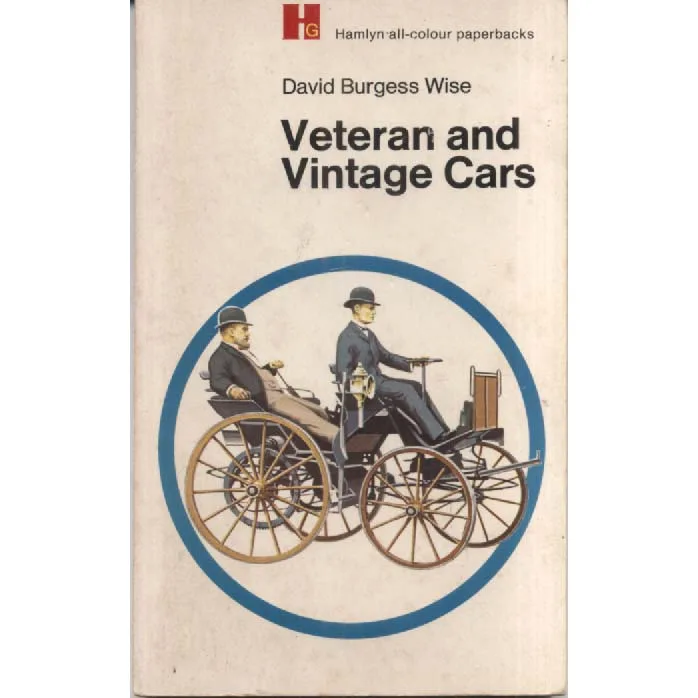
Publisher: Hamlyn
Format: Paperback
ISBN: 0600002837
Veteran and Vintage Cars (1970) by David Burgess Wise
Hamlyn | ISBN: 0600002837 | Condition: Good
There was a time when the motor car was not merely a means of travelling from one place to another, but an extraordinary mechanical adventure involving brass fittings, leather upholstery, enormous steering wheels, mysterious levers and the distinct possibility of having to stop every seventeen miles to repair something with a hammer. In Veteran and Vintage Cars, published by Hamlyn in 1970, distinguished motoring historian David Burgess Wise takes us on a fascinating journey back to the heroic early days of the automobile, when motorists were regarded as dangerous lunatics, roads were largely designed for horses and owning a car required approximately the same level of mechanical expertise as maintaining a small steam locomotive.
The history of the motor car is an extraordinary tale of invention, ambition, engineering ingenuity and the apparently irresistible human desire to travel faster than was strictly necessary. From the earliest horseless carriages to the magnificent machines of the vintage era, the automobile transformed society in ways that its pioneers could scarcely have imagined. It liberated people from the limitations of horse-drawn transport, revolutionised industry, altered the shape of towns and cities, and eventually provided humanity with the opportunity to spend several hours each morning sitting completely stationary on the M25.
David Burgess Wise was among Britain’s most knowledgeable and respected motoring historians, and this volume reflects the fascination of an age when the earliest automobiles were already being recognised as important historical artefacts. By 1970, the veteran and vintage car movement had developed a devoted following of collectors, restorers and enthusiasts, many of whom were prepared to devote their savings, spare time and domestic harmony to preserving machines that sensible people might have regarded as suitable candidates for the scrapyard.
But there is nothing particularly sensible about the love of old cars, and that is precisely what makes the subject so appealing.
The earliest motorists were genuine pioneers. They ventured onto roads designed for pedestrians, horses and carts in machines that were often noisy, temperamental and astonishingly unreliable. Starting the engine could require a considerable amount of physical exertion, steering demanded concentration and braking was sometimes more of a polite suggestion than a dependable mechanical process. Nevertheless, these adventurous individuals persevered, confident that the internal combustion engine represented the future of transport, even if the immediate future occasionally involved pushing the contraption uphill.
The veteran era produced some wonderfully eccentric machines. Manufacturers experimented with different engine arrangements, transmission systems, body styles and controls, often arriving at solutions that would seem positively alarming to the modern driver. Some vehicles possessed steering tillers rather than wheels, while others employed complicated starting procedures that required the driver to possess both considerable determination and a healthy disregard for personal injury.
Then there were the magnificent names. Daimler, Benz, Panhard, Peugeot, De Dion-Bouton, Renault, Napier, Rolls-Royce and countless other manufacturers contributed to the development of the automobile, each bringing its own engineering philosophy and commercial ambitions to a rapidly expanding industry. Many of these pioneering companies have disappeared into history, while others survive as prestigious marques whose modern products bear only the faintest resemblance to the extraordinary machines produced by their founders.
As motor cars developed, they became increasingly sophisticated, comfortable and powerful. The vintage era brought a remarkable flowering of automotive design, with manufacturers creating everything from modest family transport to spectacular luxury machines intended for wealthy owners who considered travelling without a chauffeur an unfortunate symptom of declining civilisation.
The great luxury cars of the period were masterpieces of craftsmanship. Their interiors featured polished wood, fine leather, elaborate instruments and mechanical fittings constructed with an attention to detail that bordered upon the obsessive. Some were magnificent expressions of engineering excellence, while others were essentially mobile country houses, designed to transport their occupants in considerable comfort while ensuring that the unfortunate individual responsible for driving remained sufficiently exposed to the weather to remember his position in society.
Of course, the relationship between the motor car and the British class system was never entirely straightforward. The automobile began as an expensive novelty accessible chiefly to the wealthy, but improvements in manufacturing gradually brought motoring within reach of a much wider public. The transformation from aristocratic plaything to everyday necessity was one of the great social developments of the twentieth century, although the cost of maintaining a car has since ensured that it remains a surprisingly effective method of disposing of one’s disposable income.
Motoring in the early days was also a much more conspicuous activity than it is today. A passing automobile could attract crowds, frighten horses and provoke considerable public irritation. Early speed restrictions reflected widespread concern about the dangers of these new machines, and the famous requirement for a man carrying a red flag to precede certain mechanically propelled vehicles now seems a wonderfully English solution to technological progress: permit the invention to exist, but ensure that it travels slowly enough to be overtaken by a moderately enthusiastic pedestrian.
Yet the pioneers continued experimenting, competing and pushing the boundaries of what was technically possible. Motor racing became an important arena for engineering development, encouraging improvements in engines, tyres, suspension, braking and reliability. The early racing driver was a particularly courageous individual, given that the machinery was frequently capable of travelling at speeds considerably greater than those at which it could safely stop.
For the modern enthusiast, veteran and vintage cars possess a fascination that extends far beyond their mechanical specifications. They represent an era when engineering was visible, understandable and often remarkably beautiful. Engines could be examined without first removing several layers of plastic coverings, controls were connected to actual mechanisms and a mechanical fault could occasionally be identified by listening carefully rather than connecting an expensive electronic diagnostic device and being informed that an unidentified sensor had developed a philosophical objection to continuing its duties.
There is also the extraordinary diversity of early automobile design. Before the industry settled upon familiar conventions, manufacturers pursued all manner of imaginative approaches to solving the fundamental problem of transporting people from one place to another. Some solutions proved brilliantly successful; others disappeared almost immediately, generally after demonstrating that mechanical ingenuity does not necessarily guarantee commercial viability or the continued survival of the occupants.
The preservation of these old machines is itself a remarkable undertaking. Restoring a veteran car may involve locating components that have not been manufactured for a century, researching obscure engineering details and fabricating replacement parts using techniques that modern industry has largely abandoned. Enthusiasts sometimes spend years restoring vehicles that will subsequently be driven only on carefully selected occasions, usually when the weather is suitable and a breakdown recovery service is within reasonable distance.
Such devotion might seem incomprehensible to anyone who regards a car simply as a device for reaching the supermarket. But collectors understand that these machines are tangible survivors of automotive history, preserving the craftsmanship, technological experiments and industrial achievements of earlier generations. A beautifully restored veteran car is not merely an antique vehicle; it is a moving demonstration of the extraordinary ingenuity that helped create the modern world.
Published in 1970, Veteran and Vintage Cars is particularly appealing because it represents an earlier generation’s appreciation of motoring history. The book itself is now considerably older than many of the vehicles that were regarded as classic cars when it appeared. Back then, a 1930s automobile might have been only thirty or forty years old, whereas today it approaches its centenary, a rather alarming illustration of how enthusiastically time continues passing regardless of our objections.
The volume also comes from an age when classic-car ownership was often a comparatively accessible hobby, at least for those possessing mechanical knowledge, sufficient storage space and a tolerant family. Many machines that were once regarded as obsolete curiosities have since become valuable collectors’ items, occasionally commanding prices that would have astonished their original owners. An elderly motor car that once changed hands for the price of a modest family holiday may now require the resources of an investment banker, particularly if it happens to possess the correct badge on its radiator.
And then there is the nostalgia. Vintage cars evoke a world of country lanes, leather driving gloves, brass lamps, polished radiators, running boards and wonderfully improbable journeys undertaken with little more than a map, a toolkit and a certain amount of misplaced optimism. They suggest an age before speed cameras, satellite navigation, parking apps and dashboard warning lights designed to inspire immediate financial anxiety.
Naturally, the reality was not always quite so romantic. Early motorists endured dust, rain, punctures, mechanical failures, difficult starting procedures and journeys that could become prolonged expeditions of uncertain outcome. Nevertheless, those inconveniences are considerably easier to appreciate from the comfort of a modern armchair, particularly when accompanied by a cup of tea and a handsome illustrated volume.
For collectors of motoring literature, enthusiasts of automotive history and admirers of traditional engineering, David Burgess Wise’s Veteran and Vintage Cars is an attractive addition to the bookshelf. It belongs to that particularly enjoyable category of books that celebrate machines not simply as practical objects, but as products of human imagination, ambition and craftsmanship.
It would also appeal to owners of classic vehicles who enjoy reminding younger motorists that cars once possessed character, individuality and mechanical honesty, even if that character occasionally involved refusing to start on damp mornings, leaking oil onto the driveway and requiring a complete engine overhaul after an entirely unremarkable journey to Brighton.
This 1970 Hamlyn edition is offered in Good condition by Crappy Old Books, a bookseller that feels a natural affinity with elderly mechanical objects that have survived several generations, remain perfectly capable of providing pleasure and occasionally require a little understanding from their owners. Fortunately, unlike a veteran motor car, this particular survivor does not require petrol, insurance, an annual service or a heated garage.
There is something pleasingly appropriate about purchasing a vintage book devoted to vintage cars. Both represent forms of craftsmanship and publishing or manufacturing traditions that have changed enormously over the years. Both can acquire charm through age, and both are likely to attract the attention of individuals who insist that things were better made in the old days, usually while attempting to persuade a temperamental piece of machinery to cooperate.
An excellent acquisition for motoring historians, classic-car collectors, vintage vehicle enthusiasts, engineering students or anyone who has ever stood admiring a magnificent old automobile while privately wondering how on earth its original owner managed to operate all those levers without crashing into a hedge.
A delightful journey through the pioneering decades of motoring, celebrating the inventors, manufacturers and extraordinary machines that transformed the horseless carriage into one of the most influential inventions in human history.
And perhaps there is a lesson here for modern manufacturers. The pioneers managed to create beautiful, sophisticated and increasingly reliable motor cars without fitting them with enormous touchscreens, subscription-based heated seats or electronic systems that require a software update before the windscreen wipers will function.
Admittedly, their vehicles sometimes needed to be started with a crank handle, the brakes were frequently optimistic and the roof could leak like a Victorian conservatory, but at least nobody had to accept thirty-seven pages of terms and conditions before driving away.
Crappy Old Books: keeping the golden age of motoring alive, one elderly book at a time, with no road tax, no MOT and absolutely no danger of the gearbox falling out on the way home.
And remember, should you develop an enthusiasm for collecting actual veteran cars after reading this book, the purchase price of the book will almost certainly prove to have been the cheapest part of the entire adventure.
Keep browsing: See more Transport books Other books by David Burgess Wise
